
5G aims to provide gigabits of throughput, highly reliable low-latency connections for industrial automation and other time-sensitive applications. However, to deliver, 5G networks require ubiquitous and uninterrupted 5G coverage. The major challenge is RF spectrum availability and type. 5G standards, starting from release 15, support spectra in both sub-six GHz bands and millimeter-wave bands. However, to deliver gigabits of throughput, large chunks of RF spectrum are needed, most of which are available in millimeter-wave bands. Challenging, RF free-space loss increases with operating frequency.
For example, an additional loss of approximately 8 dB occurs as we move from 800 MHz service operation to 1900 MHz service operation. This loss is more pronounced in millimeter-wave bands and RF free-space loss can be as high as or even higher than 30 dB compared to lower bands. Additionally, RF coverage is more susceptible to environmental conditions in that frequency range, meaning offering perfect coverage in an 800 MHz service area potentially requires 20 to 30 times the number of cell sites needed in millimeter-wave bands.
This creates a 5G deployment challenge for service providers in two ways:
- Deployment scale: providers would have to deploy an unreasonable number of cell sites to achieve comparable coverage area below 6 GHz.
- Spectrum availability: lower bands that are already limited in bandwidth may already have capacity limitations with LTE users.
How Can Service Providers Accelerate 5G Deployment?
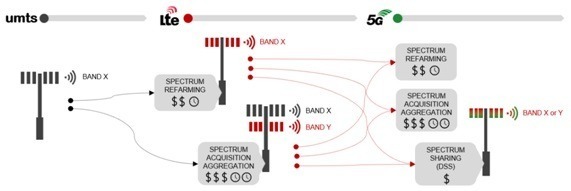
The question facing service providers is how to accelerate the pace of 5G deployment under such conditions. Typically, mobile operators acquire new spectrum to deploy a new wireless technology (2G, 3G, 4G, and 5G) or refarmer existing spectrum; however, both methodologies are costly and time-consuming to implement. Additionally, refarming may not be a good option unless the subscriber base is upgraded to the latest technology. Therefore, to deploy 5G, reusing LTE low-band spectrum when the number of 5G subscribers is small may mean a capacity bottleneck for LTE subscribers, increased interference, and degradation of existing LTE network performance.
A more agile and efficient way to introduce 5G quickly would be to dynamically allocate RF resources between 5G and LTE subscribers in the existing low-band LTE service area. This method can enable providers to maximize 5G coverage in a short period of time and, depending on high-performance demand, can deploy 5G hotspots in upper-band spectrum.
Dynamic Spectrum Sharing (DSS)
Dynamic Spectrum Sharing (DSS) technology is that x factor. In most cases, DSS can be implemented as a software upgrade to existing LTE radios, allowing service providers to accelerate 5G NR deployment and expand 5G NR coverage area without significant investment in existing low-band spectrum refarming. DSS leverages Non-Standalone (NSA) mode by dynamically and intelligently sharing low-band LTE spectrum with LTE and 5G NR subscribers. Additionally, NSA configuration allows control plane communication and mobile network management to be performed through LTE infrastructure, while the new 5G spectrum, especially in the millimeter-wave band, can be used to increase user plane traffic capacity.
Understanding the RF Environment for DSS
DSS is implemented by scheduling NR users in LTE subframes and, at the same time, guarantees no impact to LTE users in terms of essential channels, such as reference signals used for synchronization and downlink measurements (DL). The other aspect of DSS design is to adjust 5G NR reference signals within subframes so that they do not affect downlink measurements and synchronization.
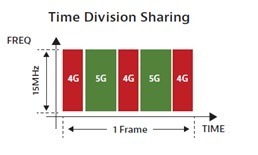
Time Division Sharing
Time-division sharing assigns different time intervals to different technologies, which is done best with LTE and 5G since both have a 10 ms frame time with 10 subframes and each subframe (1 ms) can be assigned to LTE or 5G.
This methodology leverages MBMS which allows different traffic types in LTE subframes, for example, LTE and Broadcast, or LTE and 5G.
Frequency Division Sharing
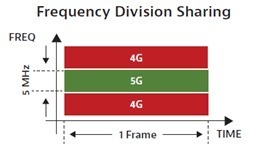
Frequency-division sharing assigns different frequency parts to different technologies, for example, an LTE signal with 15 MHz bandwidth can be divided into 3 parts of 5 MHz bandwidth each, where LTE and 5G can be independently assigned to each bandwidth part.
The disadvantage of this methodology is that it is not as dynamic as time-division sharing.
Time and Frequency Sharing
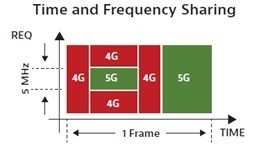
Time and frequency division sharing assigns spectrum resources in time intervals and bandwidth parts that combine LTE and 5G; however, this methodology is more challenging to implement due to the complexity of control channels and signal processing required in radios and mobile devices.
To that end, DSS considers the options shown in the figure below to ensure that NR reference signals, such as Synchronization Signal Block (SSB) or Demodulation Reference Signal (DMRS), are placed in time-frequency away from any collision with LTE signals. Multi-Broadcast Single-Frequency Network (MBFSN) is used in LTE for point-to-multipoint transmission, such as Evolved Multimedia Broadcast Multicast Services (eMBMS). The general idea of MBSFN is that specific subframes within an LTE frame are reserved and free from other LTE channel transmission. These symbols are intended to be used for broadcast services and are not used for data transmission to other LTE devices. In DSS, these reserved symbols are used for 5G NR signals instead of eMBMS.
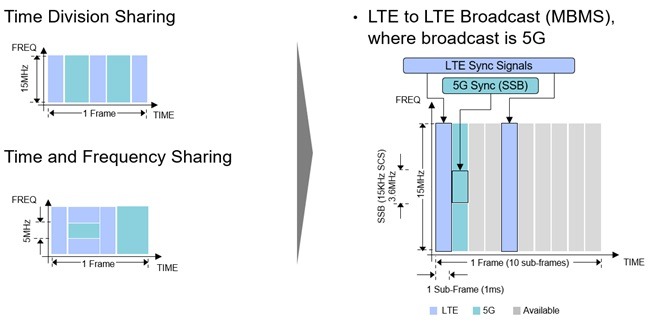
The use of MBSFN is completely transparent to legacy LTE-only devices. This method also has disadvantages: primarily, if MBSFN subframes are used frequently, it takes resources from LTE users, reducing the performance of LTE users. As we all know, nothing is free, therefore implementing DSS in an LTE service area also presents some challenges:
- Spectral efficiency impact that can result from additional management "overhead" traffic required by DSS.
- Optimization of traffic management policies, basically managing capacity versus user experience and overall user experience for both LTE and 5G.
- Isolating performance issues (interference, signal quality or network) for LTE and 5G simultaneously and the mutual effect they have on each other.
- DSS
- RF characterization to validate performance requirements and 3GPP compliance testing of LTE and 5G NR radios
- 5G beam analysis and LTE reference signal power analysis
- NSA Scanner that offers signal quality measurement and 5G beam/channel power measurement along with LTE reference signal/channel power measurement
- NSA Route Map provides 5G and LTE coverage simultaneously
- DSS conformance verification according to 3GPP standard.
- DSS Modulation Analysis: concurrent 5G and LTE, channel mapping, frame and subframe analysis, data constellation and timing error.
- DSS OTA (Over-the-Air) Analysis: concurrent 5G and LTE channel scanner, frequency and timing error, and
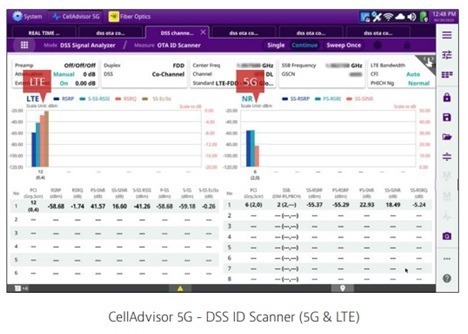
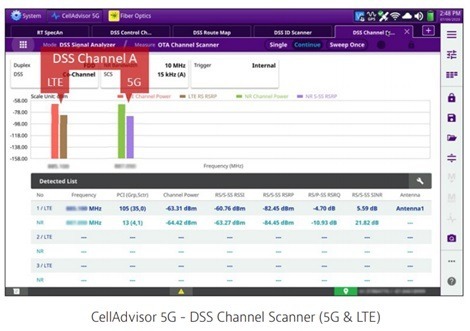
With the right testing solution, service providers can easily accelerate their 5G deployments and can be confident that their DSS implementation does not suffer notable user performance degradation.